Address: Wollongong NSW


Why Wollongong Roofs Develop Moss So Quickly
If you have noticed moss creeping across your roof within a few years of having it cleaned or painted, you are not imagining things. Wollongong roofs develop moss faster than roofs in many other parts of NSW, and there are specific local reasons for this.
The Climate Conditions That Drive Moss Growth
Moss is a primitive plant that thrives in cool, moist, shaded environments. Wollongong’s Illawarra climate provides all three:
- Coastal humidity — the Tasman Sea keeps the Illawarra coast consistently more humid than inland areas, particularly at night and in the early morning when moss growth is most active
- Seasonal rainfall — Wollongong receives around 1,200 mm of rainfall annually, significantly more than western Sydney, providing sustained moisture for biological growth. Sources: Bureau of Meteorology
- The escarpment shadow — homes at the base of the Illawarra Escarpment receive less direct afternoon sun, particularly on south-facing sections, creating extended periods where roofs remain damp after rain
Why Some Roofs Are Worse Than Others
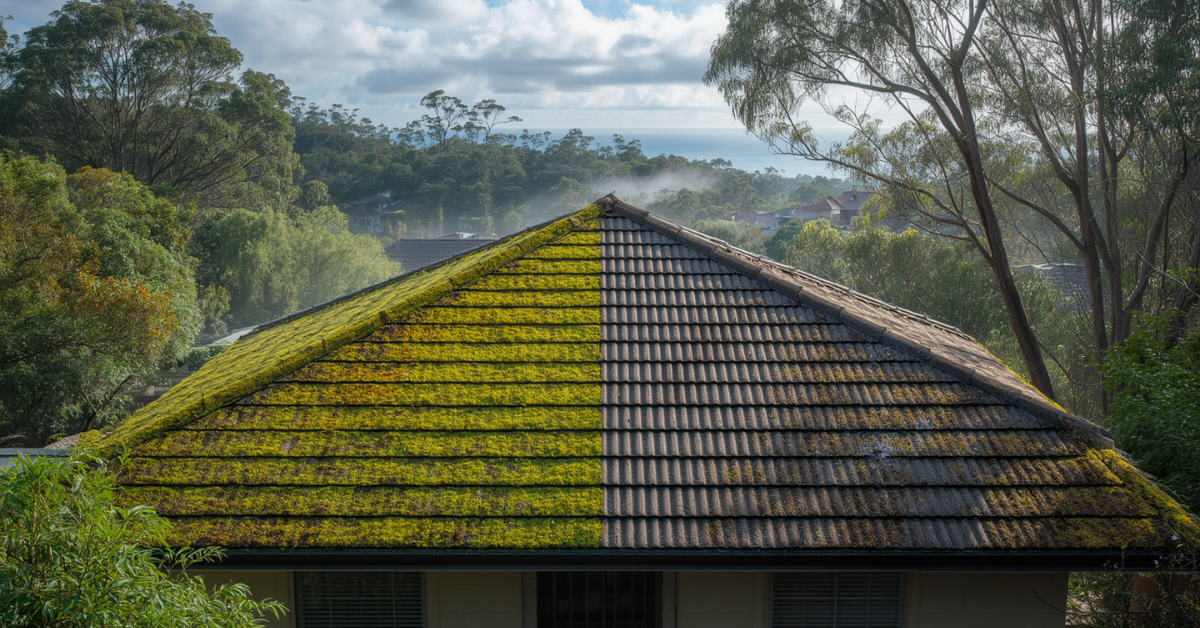
- Large overhanging trees — shade from trees is the single biggest accelerant for moss growth; the affected sections of roof can be years ahead of open, sun-exposed sections in terms of biological growth
- Concrete tiles — more porous than terracotta, concrete tiles absorb moisture more readily and provide a better substrate for moss to establish
- North or south-facing roofs — south-facing roofs receive less sun and dry more slowly after rain
- Valleys between roof sections — these areas trap debris and retain moisture longer than pitched open sections
[ Screenshot: Moss growth on a Wollongong tile roof, particularly near escarpment properties ]
Why Cleaning Alone Is Not Enough
Pressure washing removes visible moss but does not kill the root system. Moss removed by pressure washing without prior biocide treatment tends to re-establish faster than moss that was never disturbed, because the root system remains alive and the disturbed material spreads to new areas of the roof surface. The correct sequence is: biocide treatment first, allow contact time of 24 to 48 hours, then pressure wash. This kills the root system before physical removal.
How Paint Can Help
Roof paints with integrated mould and algae inhibitors slow biological re-establishment after cleaning. Products like Solver Roof Guard and Dulux Weathershield Roof and Trim include these inhibitors as part of their formulation, and they do meaningfully extend the moss-free period after a professional clean and repaint. The inhibitors can stretch the interval between significant cleanings from two to three years to five to six years.
Practical Tips for Homeowners
- Trim overhanging branches to increase sunlight exposure to roof sections prone to moss
- Clear valleys and gutters of leaf litter that retains moisture and provides organic material for moss to grow on
- Treat localised moss patches early, before they spread to larger sections of the roof
Final Thoughts
Wollongong’s moss problem is a function of the local climate rather than poor maintenance. Understanding what drives it means you can manage it effectively rather than being surprised when it returns.
For professional roof cleaning and repainting, our roof painters Wollongong team includes biocide treatment as standard. See our roof painting in Wollongong guide for the full context of what a professional job involves.